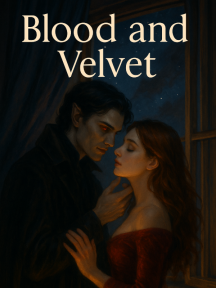

Blood and velvet

-
---
The storm came in quiet.
No thunder. No lightning. Just the steady hush of fine rain sweeping across the rooftops like a secret being whispered from cloud to cobblestone. The night air shimmered with moisture, clinging to iron gates and ivy-covered walls. Every streetlamp flickered like it was remembering something it had once feared.
Rue de Lys was nearly deserted, just the way Seraphina Aldane liked it.
She sat behind the counter of Étoile Noire, her family’s crumbling bookshop, with her legs curled beneath her and a cold cup of tea at her elbow. A thin shawl was draped over her shoulders, and a pencil was tucked behind one ear, forgotten. She was reading, of course, some battered leather volume written in a language even her university professors had once told her to avoid.
Dead languages were her specialty.
So were dead things, in general.
The shop was warm, lit by a small fire in the hearth and the golden glow of a single oil lamp on the counter. Shadows curled between the tall shelves like cats asleep in the corners, and the smell of old paper mingled with the rain and the fading lavender she kept tucked in jars on the windowsills.
Outside, the storm thickened.
Then the bell over the door rang.
A single, sharp note cut through the silence.
Seraphina’s head jerked up. She wasn’t expecting anyone. She never had customers this late, certainly not during a storm, and the shop’s front window bore a sign turned clearly to read: CLOSED.
The man who stepped through the doorway didn’t seem to care.
He was tall, easily over six feet, with shoulders that filled the narrow entrance. He wore a cloak the color of drying blood, deep crimson with hints of black in the folds. Rainwater shimmered on the velvet like glass. His hood was still drawn over his face, and when he stepped forward, the scent of cold wind and something darker followed him inside.
Seraphina’s heart stuttered. Just once.
She didn’t know why.
The stranger paused just inside the shop. The door swung shut behind him with a quiet click, and in that instant, something shifted.
The silence wasn’t just silence anymore. It was listening.
The shadows weren’t just shadows. They leaned toward him, ever so slightly.
"Can I help you?" she asked, keeping her voice steady.
The man lifted his head.
Then he pulled back his hood.
Seraphina had seen beauty before. She had studied sculpture in Florence, walked through museums in Paris and Vienna. But this wasn’t beauty. It was something sharper, something ancient and sculpted with intention.
His face was pale, nearly luminous in the lamplight, with high cheekbones, a mouth made for poetry or war, and eyes that—
She froze.
His eyes were black.
Not dark brown. Not shadowed gray. Black, like a well with no bottom, no light, no end.
And yet, they weren’t lifeless.
They shimmered.
"I’m looking for something," he said.
His voice was like velvet soaked in smoke, smooth, slow, and unreasonably warm against her ears.
She blinked. "You’re aware we’re closed, right?"
He smiled faintly. "I am."
"And you’re here anyway."
"I am," he repeated, sounding completely unbothered. "Because I don’t want a book. I want a memory."
That stopped her.
"A memory?"
"Yes."
She cleared her throat and stood, careful to keep the counter between them. "Most people come in looking for first editions. Rare bindings. You want a memory?"
"Something written before memory was replaced by history," he said. "Something raw. Something that still bleeds when you read it."
She stared at him. "You’re in the wrong shop."
"I don’t think I am."
He moved slowly along the far shelf, fingertips gliding just above the books’ spines but never touching. The air behind him felt heavier, like the room itself was holding its breath. She noticed, absurdly, that despite the wet cloak, he left no puddle on the floor. No sound followed his boots. No scent clung to the air, except something faintly metallic, like silver coins or old blood.
And then it struck her.
He cast no shadow.
The fire flickered. Her own silhouette stretched faintly behind the counter, caught in the wavering light.
His? Nothing.
She swallowed and stepped out from behind the counter.
"That book you’re reaching for hasn’t been touched in years."
He plucked the volume from the shelf. It was thin, bound in faded leather that looked half-flayed, its title nearly rubbed away.
"I know."
"You speak Occitan?"
"Yes."
"You’re fluent?"
He didn’t answer. He opened the book with reverent care, turning the brittle pages like he’d held them before. He didn’t squint. Didn’t hesitate. His eyes flicked across the ancient script like it was a nursery rhyme.
"That was written by a plague survivor," she said, more to fill the silence than anything. "He claimed to have visions. Drew maps of cities that don’t exist."
"Some cities disappear for a reason," the man murmured. "They aren’t meant to be found again."
She folded her arms. "Do you want to buy it?"
He looked up at her. "Would you sell it?"
"I don’t sell books to people who show up soaked and cryptic in the middle of a storm."
There was a pause.
"Would you make tea for them?"
She blinked.
"What?"
"I’d like a cup of tea," he said, like it was the most natural thing in the world. "If you’re offering."
"I wasn’t."
"You will."
Against her better judgment, Seraphina led him upstairs to the apartment above the shop. She told herself it was just curiosity, or manners, or a strange pull that hadn’t left her since the moment he stepped through the door.
Her hands moved without thinking, boiling water, selecting a chipped mug, pouring honey she almost never used. He leaned against the archway between her kitchen and sitting room, cloak removed now and draped over a chair like a royal banner.
He wore black beneath it, a silk shirt, narrow trousers, hands with long, elegant fingers that had never known calluses.
"You live here alone," he said. It wasn’t a question.
She nodded. "Been alone most of my life."
"And yet you don’t seem lonely."
"I keep myself busy."
"That’s not the same as not being lonely."
She paused. "You’re very comfortable in other people’s homes."
"I’ve lived in many. Some older than this one. Some that no longer exist."
There was something in his tone, not arrogance, but distance. Like he was remembering something so long ago it hurt.
"Why are you really here?" she asked.
He took the mug from her hands, his fingers brushing hers. They were cold, but not lifeless. Like marble.
"I told you," he said. "I’m looking for a memory."
She frowned. "Whose?"
He sipped the tea. "Yours.