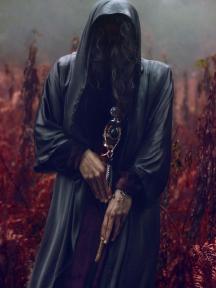

The Ghost app

The lecture hall was nearly empty when Professor Birju finally set down his chalk. His slender fingers were smeared white, the faint powder clinging to the lines of his wrinkled hands. He turned to look at the board once more, where complicated formulas stretched from one end to the other, tangled equations about quantum energy and wave transmission. To the few remaining students in the back row, it was nothing more than abstract symbols, but to Birju, they were the language of his life.
“Remember,” he said, his voice gravelly yet firm, “knowledge is not something you carry only in your notebooks. It must live inside your mind. Else it is like a book locked inside a glass case—beautiful but useless.”
The students nodded, though most of them were already half-thinking about the buses they needed to catch, or the assignments due in other classes. At sixty-three, Birju had learned not to expect too much from them. He packed his notes into a worn leather briefcase and dismissed the class.
The hallway outside was buzzing with life—young men and women rushing between classrooms, the smell of canteen samosas drifting through the air. But Birju walked through it all like a shadow, unnoticed and unbothered. His students respected him, certainly. Some even admired him. But no one truly knew him.
His life was simple, almost mechanical. In the morning, he would walk from his house through the quiet stretch of forest road to the college. He taught, he researched, and in the evening he would return the same way. His home, a modest two-story house with peeling paint and overgrown vines, stood near the edge of the jungle, far enough from the city to be silent at night. There was no wife waiting, no children to bring him joy or trouble. Only books, old memories, and an endless stream of ideas filled his evenings.
That night, as he stepped out of the college gate, the sky was painted in shades of purple and orange. The sun had dipped low, leaving only a thin ribbon of light across the horizon. Birju adjusted his spectacles and sighed. He had stayed later than usual, caught up in calculations for a new paper he was preparing. The air was cooler now, with a bite of evening chill, and the path to his house seemed longer than ever.
His route took him past the old graveyard—a place that most villagers avoided after dark. Students often joked about it, whispering stories of spirits and shadows. Birju, ever the man of science, dismissed such nonsense. Still, even he couldn’t deny that the place carried an unsettling silence, especially as daylight faded.
As he approached the rusted iron gates of the cemetery, he slowed his steps. The gravestones inside stood crooked and worn, many of them cracked with age. Creepers curled around them like skeletal fingers. The wind carried a faint smell of damp earth.
Birju tightened his grip on the briefcase. “Nonsense,” he muttered to himself. “Just stones and soil. Nothing more.”
But then he saw her.
At first, it was just a figure—slim, almost delicate, standing a few feet from a low tombstone. The dim light made it difficult to see her clearly, but he could make out long hair swaying in the breeze. His heart skipped a beat. What was a young woman doing here, at this hour?
“Hello?” he called out, his voice echoing strangely against the stones.
The figure did not move. Birju’s eyes shifted—and that was when he saw the body. A man lay on the ground, twisted unnaturally, his clothes stained dark. Even from a distance, Birju could see that the man was dead.
Cold fear shot through him. He stumbled forward, trying to understand what he was seeing. “What… what happened here?” he whispered.
The girl still stood silently, her back to him. He took another step. “Miss? Are you all right? Did you see what happened?”
As he reached out to touch her shoulder, the world seemed to freeze. Slowly, ever so slowly, the girl turned her head.
But before Birju could glimpse her face, her form dissolved into a swirl of gray smoke, vanishing into the air.
His hand touched nothing but emptiness.
For a long moment, Birju stood frozen, unable to breathe. His heart thundered in his chest. He looked down again at the corpse, the metallic smell of blood growing stronger. The man’s eyes were open, staring lifelessly into the sky. A knife protruded from his stomach, glinting in the last traces of twilight.
Birju staggered back. His mind screamed that this was impossible—people did not simply vanish into smoke. He wanted to run, but his legs felt heavy, trapped between fear and disbelief.
Then came the sound of footsteps. Voices.
He turned to see two villagers standing at the gate, eyes wide as they took in the scene: the corpse on the ground, the old professor standing beside it.
“There he is!” one of them shouted. “He killed a man!”
“No!” Birju cried, his voice cracking. “I didn’t—he was already—listen to me!”
But it was too late. The men were already running to call the police.
Within minutes, the flashing red lights of a jeep painted the graves in eerie colors. Officers stormed in, pulling Birju away from the body. Questions rained on him, accusations piling like stones. His explanations sounded hollow, even to his own ears.
And when they saw the knife still lodged in the victim’s body, the blood on the ground, and the old man trembling beside him, the conclusion was inevitable.
“Professor Birju,” the inspector said coldly, “you are under arrest for murder.”
Birju’s world shattered.
He looked once more at the spot where the mysterious girl had stood, but there was nothing—only shadows, and the whisper of the wind among the graves.