content


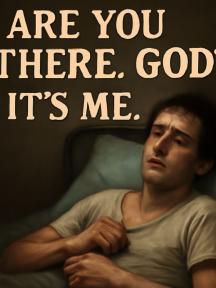
"Are You There, God? It’s Me." That was all he could say.The words clung to his lips like a final breath, and then came the tears slow at first, then endless, like a dam had given way inside his soul. His cheeks were rivers, his heart a desert crying for rain.
Around him, the room held its breath.
Doctors turned away. Nurses stared at the floor. And Serah... dear Serah she tried. She gripped his hand, swallowed her sobs, bit her trembling lip. But the moment shattered her, and she crumbled beside him, tears spilling onto his hospital gown like prayers unanswered. A nurse placed a gentle hand on her shoulder, and without a word, led her out. Out of the room, Out of the moment,
Leaving behind the boy who still believed enough to ask the question. Even when Heaven was silent.
The anesthetic had already been administered. Whether to ease his passing or to hold his body steady in hope of a miracle no one could say for sure. He lay still on the hospital bed, chest rising and falling in soft defiance, as though his soul had made a quiet pact with time to wait just a little longer. The truth was cruel in its simplicity: he needed a liver transplant. Urgently. But there was no donor in sight. He had no family. None that were living. At just five years old, he had survived the kind of tragedy that leaves permanent echoes; a ghastly motor accident that had stolen both his parents from him in an instant. Their faces had long blurred in his mind, replaced by distant sounds of glass shattering, sirens wailing, and the cold silence of grief that followed.
Since then, he had grown up in homes that never really felt like home. Adopted once, returned twice. He was passed along like borrowed furniture. No one wanted to keep what felt broken.
Now, years later, with tubes running into his veins and machines keeping him company, the brokenness had taken on a new form—one he could not fix with silence or strength. His body was giving out.
The doctors had done everything they could. Lists were checked. Calls were made. But there were no willing donors. Not one among the few friends he had ever made. Not one distant relative. No one willing to give even a day’s worth of sympathy, let alone a part of their own liver to save his life. Except Serah. Serah had come. And she had stayed. She was not family by blood, but she was the only family he had. She wasn’t rich. She wasn’t powerful. She had no magic cure. But her presence filled the sterile room with something the others couldn’t bring (humanity).
She held his hand when the pain grew sharp. She read to him when his voice grew too weak. She tried to smile, even when her eyes were glassy with tears. Serah had done more than cry, she had offered her own liver. But the test results came back negative. She wasn’t a match. She broke down in front of the doctor that day, whispering apologies he didn’t deserve, crying as though her heart were being ripped apart. “I should be enough,” she had said. “Why can’t I be enough?” And yet, even after the rejection, she stayed. She stayed when the nurses started preparing him “just in case.” She stayed when his strength slipped into sleep. She stayed, watching over him like a prayer in human form.
Outside the window, the world kept spinning. People laughed, cars moved, children played. But in that quiet room, filled with the scent of antiseptic and the humming of machines, only one thing mattered: A boy on the edge of life. And the girl who refused to let him cross that edge alone.
Suddenly, his heart began to beat faster. It wasn’t just a flutter, it was a storm. A frantic, uneven thudding that sent ripples of panic through the room. The monitor’s beeping accelerated like a siren warning of something no one could stop. Nurses rushed in. One called out a code. Another pressed his chest gently, whispering his name, hoping he could still hear it. But he was already slipping. The pain dulled. The sound faded. The room, the people, the world, they all receded into silence.And then... there was nothing. Just stillness.
His body fell into a coma, but his mind opened like a door he had long forgotten how to unlock. What met him on the other side was not darkness or fear—but light. Warm, golden light that wrapped around him like a memory.
He was five again.
And they were there. His mother, kneeling in front of him, brushing crumbs from his cheeks with her familiar laugh that always melted his sadness. His father, tall and strong, lifting him high above his shoulders and spinning him around until the sky felt close enough to touch. The world smelled of pancakes and Sunday morning. He could hear the clinking of cutlery, the music of his mother humming in the kitchen, the rustle of the newspaper in his father’s hands. It was all so real. So painfully, beautifully real.
He was no longer a dying boy in a hospital bed. He was their son. Whole. Loved. Optimistic about his future. They were in the park now. Feeding pigeons. He remembered that day, the way his mother pulled him close to zip up his jacket, the way his father let him hold the bag of crumbs like he was trusted with treasure. He remembered the wind, the laughter, the way time felt like it would never end.
And then, the dreams came. Not dreams of fantasy, but the ones he had once believed in with all his heart. He was standing in front of the mirror in their old living room, arms stretched wide like airplane wings. He wore a cap made of folded newspaper and a badge scribbled in crayon. “I’m going to be a pilot,” he had said, with pride in his voice and stars in his eyes. “I’ll fly all around the world.” His parents had cheered. His mother had kissed his forehead. His father had saluted him with a laugh. And for a moment, the world was full of skies waiting for him.
But then, like a film running out of reel, the colors began to fade. The warmth retreated. The laughter echoed away into silence. The memory unraveled. Because they were gone. Because time had moved on. Because life had taken a turn no child should have to face.
The dreams, those beautiful, sky-high dreams had dimmed slowly with each foster home, each rejection, each day he awoke with no one to tell him he mattered. The idea of flying had been replaced with the reality of surviving. And the boy who once dreamed of wings had learned only how to fall and brace for the landing.
Now, suspended in the liminal space between life and death, his soul grasped at those fading pieces. Not to change the past but to remember that once, even if only for a while, he had been deeply loved. He had believed. He had wanted to live, not just exist. And maybe, just maybe, that mattered.
As the memory folded back into the corners of his pain, a tear escaped, gliding silently down his cheek. It had been weeks, three long weeks since his body had slipped into a coma. Since the machines took over where his strength gave way. Since hope had dimmed like the lights in a quiet hospital corridor.
But now, that tear caught the eye of the one person who never left his side.
Serah saw it.
Her breath caught in her throat. She blinked once, then again, unsure if it was real. But then, another tear slid across his cheek. Her chair clattered to the floor as she jumped to her feet.
"Doctor!" she screamed, voice cracking. "Doctor, please come quickly!"
Down the hallway, the doctor paused. He had long accepted what others couldn’t say aloud: that nothing more could be done. That life was slipping, slowly and silently. He followed her anyway, reluctantly, expecting nothing more than another collapse of hope. But the moment he stepped into the room, time seemed to freeze.
The boy's eyes were open. The doctor stood stunned, speechless. He moved closer, leaning in, blinking in disbelief. He placed a trembling hand on the boy’s wrist. The pulse was strong. Alive. Awake. Medical personnel swarmed in. Machines beeped. Charts were checked, tests were run. And what they found was unlike anything they had seen before. The liver, the failing organ that had sentenced him to death was healing. On its own. No transplant. No medication. No scientific explanation.The tissue showed rapid regeneration. The complications were gone. It was as though something, someone had reached into his body and rewrote his ending.
But there was more to the story.
In that long, quiet coma, while machines whispered life into him, he had seen something far beyond the realm of medicine. He remembered weeping not from pain, but from the ache of memories, from the weight of dreams that never got their chance. And in that shadowy space between life and death, an angel appeared. She looked just like his mother gentle eyes, warm smile, hands that carried peace. She didn’t speak. She didn’t need to. She reached out, wiped the tears from his sleeping face, then placed her palm softly over his abdomen. Over the place where the pain had lived for so long. He remembered the warmth. It wasn’t fire. It was light. It filled him until the pain dulled and the darkness faded.
Then she was gone.
And when he opened his eyes, life had begun again. The story spread. Hospitals called it a miracle. Journalists called it a phenomenon. People from across nations wanted to know who this boy was, this one who defied death, who returned with a story that couldn’t be explained, only believed. Help came. Love came. Crowds came.
And in the years that followed, the boy who once laid forgotten in a quiet hospital room rose to become a man who changed lives. He stood before crowds not as a pilot, as he once dreamed but as something far more powerful.
A preacher.
A healer.
A voice for the wounded and a voice of hope.
A light for the lost.
And that boy’s name… was Moses Samuel!
“To Be Continued”