content


(POV: Li Wei)
The city greeted him with rain.
Sheets of water blurred the skyline as Li Wei stepped out of the airport terminal, his leather shoes already damp from the puddles collecting near the curb. Shanghai’s towers pierced the low clouds like glass spears, their neon crowns glowing faintly through the storm. Even in this weather, the city was restless—taxi horns blaring, umbrellas colliding, people rushing as though the rain were only a minor inconvenience.
For Li Wei, it was a reminder, he was no longer in Beijing.
Beijing’s rain was different. Summer storms came down hard, flooding the old hutongs, pooling in courtyards that smelled faintly of earth and brick. Here, in Shanghai, the rain belonged to glass and steel. It slicked across skyscrapers, turned the Bund into a watercolor painting, and mingled with the glow of neon so that the entire city seemed to shimmer as if under a silk veil. It was beautiful. It was cold.
The cab ride stretched for nearly an hour, raindrops racing down the window beside him in uneven trails. He leaned his head back against the seat, but his mind refused to quiet. His phone vibrated nonstop in his pocket, each buzz a reminder of the tether he could never cut. Another message from his mother. He didn’t bother checking, it would say the same thing as always.
Don’t forget why you’re there.
The Chen family expects dinner next week.
Your career depends on this project.
Her words were carved into him, sharp as jade.
Family duty had followed him even here, clinging to him like the humidity. No matter how far he traveled, he carried the weight of his father’s company, of a lineage that demanded he succeed. His father used to tell him that personal desires were like rain on stone, they might leave a mark, but duty was the stone itself, unyielding and permanent.
Li Wei closed his eyes, but even then, the past pressed against him. He remembered late nights at the office in Beijing, working until dawn only to hear his father say it still wasn’t enough. He remembered dinners where silence stretched longer than conversation, his mother’s careful questions about his life always circling back to business, reputation, and alliances.
When the taxi finally pulled up to his new residence, Li Wei stared at the building with a hollow expression. A gleaming high-rise of steel and glass, the kind that mirrored the skyline until the city looked like it was folding in on itself. The lobby smelled faintly of marble polish and artificial lilies. Everything was immaculate, expensive, lifeless.
The doorman greeted him with a shallow bow. His polished shoes clicked across the marble floor, echoing in the cavernous silence of the lobby. He gave his name to the receptionist, received his keycard, and took the elevator up. Even the elevator was pristine, its mirrored walls reflecting back a man who looked as though he belonged, tall, sharp suit, controlled expression, but whose eyes betrayed exhaustion.
Inside his apartment, he set down his suitcase and took a slow look around.
White walls. Minimalist furniture. Floor to ceiling windows overlooking the Bund. It was a place built for efficiency, not comfort, a space that could belong to anyone. He ran a hand along the sleek counter of the kitchen, but the surface felt cold, like the silence pressing down on him.
This was supposed to be a fresh start, but instead it felt like exile.
He loosened his tie, walked to the window, and let the city lights smear across his reflection. Somewhere far below, the streets pulsed with color lanterns glowing through the drizzle, couples sharing umbrellas, laughter escaping from restaurants. He imagined what it might be like to be down there instead of up here, where the glass isolated him from the pulse of life.
He had all of Shanghai at his feet, and yet the loneliness in his chest was louder than the storm outside.
Li Wei picked up his phone. Three missed calls from his mother. One from his assistant about tomorrow’s meeting. Nothing else. Not a single message that wasn’t tied to obligation.
The silence mocked him. He almost wished for a meaningless text, something frivolous, even spam, anything that wasn’t a reminder of his responsibilities. But his contacts list was filled with colleagues, family, and business partners. Not friends and certainly not lovers.
With a sharp exhale, he grabbed his coat again. The rain hadn’t stopped, but maybe if he walked the streets just for a little while he could forget the echo of his family’s expectations. He wanted noise, warmth, something that didn’t feel like marble and glass.
The elevator ride down felt endless, but when the doors finally opened, the damp air rushed in, carrying with it the mingled scents of wet asphalt, chestnuts roasting at a vendor’s stall, and faint traces of perfume from passing strangers.
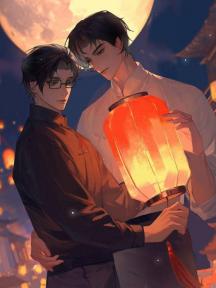
Down on the street, neon signs flickered against the wet pavement. The smell of roasted chestnuts drifted from a corner vendor. Lanterns, half soaked but stubbornly burning, floated outside a row of shops. The red glow blurred in the rain, smearing like ink across water.
He walked without direction, letting the city’s rhythm guide him. A couple laughed under the cover of a shared umbrella. A child tugged at his mother’s hand, pointing up at the drifting lanterns. Somewhere nearby, a street musician strummed a guitar, the notes trembling but steady against the rain.
Then he saw it.
A small café tucked between two taller buildings, its warm light spilling onto the rain-slick street. The sign above the door was modest “CAFFE” in fading red letters. Through the window, he glimpsed shelves lined with jars, a counter cluttered with mugs, and a young man wiping tables with the absent-minded grace of someone who belonged to the place.
Li Wei paused. He couldn’t explain why, but the glow of that café pulled at him more than any glass tower ever had. Something about the scene felt…human. It wasn’t the luxury of imported coffee machines or designer interiors. It was the warmth, the condensation on the windows, the faint golden light that softened the rain outside, the way the young man’s movements seemed unhurried, uncalculated.
He realized, with a sudden ache, that he hadn’t stepped into a place like this in years. Not since university, when he and his classmates would hide from exams in cramped teahouses, sipping oolong and debating the future as though it were theirs to shape. Back then, his laughter had been unguarded. His smiles were real.
He reached for the handle.
And as the bell above the door chimed, Li Wei stepped into the first place in Shanghai that felt alive.