content


The jeep jolted as it rolled down the uneven road, its siren still whining though there was no traffic to clear. Inside, Professor Birju sat sandwiched between two police constables. His spectacles had slipped halfway down his nose, and his briefcase had been snatched away, tossed carelessly onto the floor. His wrists were bound with cold steel handcuffs that bit into his thin skin.
He kept shaking his head in disbelief. “This is a mistake,” he whispered again and again, as though repeating the words might make them true.
The constable beside him snorted. “We hear that every day. Murderers always say they’re innocent.”
“I am not—” Birju began, but his voice cracked. He looked out the window instead. The iron gates of the graveyard were already behind them, disappearing into the darkness. For the first time in years, he felt utterly powerless. Equations, logic, science—all the things that had carried him through life—were useless here.
At the police station, the chaos was overwhelming. Typewriters clacked, phones rang, officers shouted instructions. Birju was shoved into a wooden chair in front of a heavy desk where Inspector Rao, a broad-shouldered man with sharp eyes, waited.
“So,” Rao said, leaning forward, “Professor Birju. A respected man, they say. Yet we find you standing over a corpse with blood on your hands. Quite the scandal, hm?”
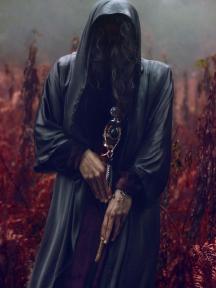
“There was a girl,” Birju blurted. His voice was trembling, but he forced himself to meet the inspector’s gaze. “A girl was standing there. She vanished—like smoke. You must believe me.”
Rao raised an eyebrow. “A girl who turns into smoke?” He chuckled without humor. “Do you take us for fools?”
Birju’s words stumbled over each other. “I… I touched her shoulder. She wasn’t human. And the man—he was already dead when I arrived. I swear it.”
But his explanation sounded like madness, even to himself. The officers around the room exchanged knowing glances. One of them muttered, “Old man’s losing his mind.”
The inspector’s expression hardened. “You’re saying ghosts exist, is that it? That some spirit killed this man and framed you?”
“Yes!” Birju said desperately. “That is exactly what happened. I have no reason to kill anyone. I am a professor, a scientist!”
Rao slammed his palm on the desk, startling everyone in the room. “Enough! We found you at the scene, and the villagers saw you. The evidence speaks louder than your fairy tales.”
Birju’s heart sank. He realized no amount of truth would save him here.
That night, he was thrown into a narrow cell. The cement floor was damp, the smell of sweat and rust clinging to the air. He sat in the corner, hugging his knees, his mind replaying the moment again and again—the figure of the girl, the smoke, the corpse. Who was she? Why did she appear to him? And why couldn’t anyone else see the truth?
Hours stretched into days. Birju was interrogated repeatedly, but his story never changed. The police, however, only grew more convinced that he was insane—or guilty, which to them was the same thing.
When his trial began, the courtroom was packed. Journalists scribbled furiously, eager to report the fall of a once-respected academic. The villagers who had seen him near the graveyard testified with certainty: they had witnessed the professor standing over the body, looking guilty as sin.
The prosecutor painted a simple picture. “This is a man of intelligence,” he said, pacing the courtroom. “But intelligence breeds arrogance. He thought he could commit murder and escape by weaving stories of ghosts and smoke. But the truth is plain—Professor Birju is a killer.”
Birju sat silently at the defense table, clutching his trembling hands. His lawyer tried to argue lack of motive, his spotless record, his years of service to the college. But against the damning evidence of circumstance, the arguments seemed hollow.
When Birju himself took the stand, he spoke with passion. “I did not kill that man,” he declared. “I am telling you—there was a presence, something not of this world. I saw her. She was there.”
The courtroom rippled with murmurs. Some laughed, others shook their heads. Even the judge’s face betrayed disbelief.
In that moment, Birju felt the crushing weight of isolation. His truth had no value here. Science could explain many things, but not what he had witnessed that night.
Finally, the gavel struck. The judge’s voice was firm, merciless. “Professor Birju, you are hereby sentenced to fifteen years in prison for the crime of murder.”
The words echoed like thunder in Birju’s ears. His knees nearly buckled as two constables dragged him out of the courtroom.
The world outside blurred as the news spread. A respected scientist turned criminal. A once-great teacher now branded a murderer. For many, it was a cautionary tale: even the most intelligent could fall.
But for Birju, it was the beginning of a nightmare.
In the prison that swallowed him, days lost all meaning. He marked time only by the meals shoved through the bars. Other prisoners jeered at him, calling him “the ghost professor.” He tried to bury himself in thought, scribbling equations with pieces of chalk when he could find them, but even mathematics felt empty now.
Late at night, when the prison grew quiet, he would close his eyes and see her again—the girl at the graveyard, her back turned, her face hidden. Always the same, always just out of reach. And the corpse beside her, lifeless eyes staring into nothingness.
The image haunted him more than any cell could.
And though he tried to dismiss it as a hallucination born of exhaustion, something deep inside told him otherwise.
This was no dream.
Something was waiting for him, beyond the walls of the prison, beyond the world of the living.
Something that would not let him rest until he discovered the truth.